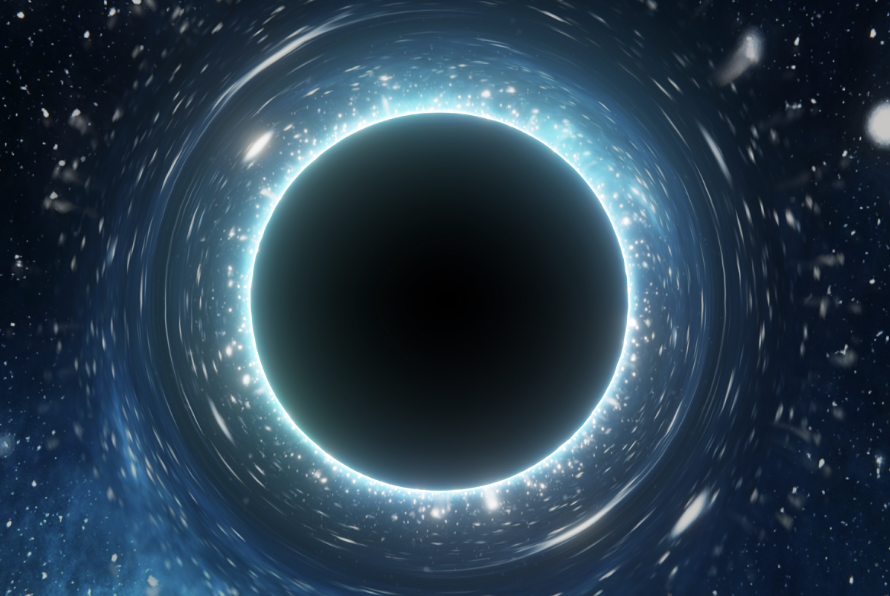
Gaia BH3 is an extraordinary binary system located about 590 parsecs, roughly 1900 light-years, from Earth. It contains a black hole about 33 times the mass of the Sun, the most massive known black hole of stellar origin, accompanied by an ancient low-mass star.
Using the UVES spectrograph on ESO’s Very Large Telescope, an international team led by ULB researchers analysed 51 chemical elements in the companion star, from lithium to uranium.
The star’s light acts as a cosmic archive, preserving the chemical composition of the gas from which it formed early in the history of the Milky Way.
Its abundance pattern reveals enrichment by a small number of massive-star explosions and by the rapid neutron-capture process responsible for producing many heavy elements.
Comparison with four stars from the disrupted ED-2 stellar system suggests that this chemical signature was inherited from their common birth environment, rather than deposited directly by the progenitor of the black hole.
The study connects the formation of an exceptional black hole with the first supernovae and the chemical evolution of one of the Galaxy’s oldest stellar populations.
“ The chemical fingerprint of the Gaia BH3 system. Evidence for early cluster enrichment from the analysis of 51 elements ”
Gregory Vanden Broeck, Thibault Merle, Nhat Tan Mai, Sophie Van Eck, Stéphane Goriely, Lionel Siess, Alain Jorissen, Do Thi Hoai
Accepted in A&A Letter on July 16, 2026